
SonicPure Pulsar 4400 vs. Narrow/Adaptive Tuning
Broad-spectrum algae control without the retuning cycle.
Most systems react to the algae bloom you can already see. SonicPure Pulsar 4400 uses a constant sweep of 4,400 discrete frequencies to provide broader, more proactive protection across changing water conditions.
The Problem with Narrow Tuning
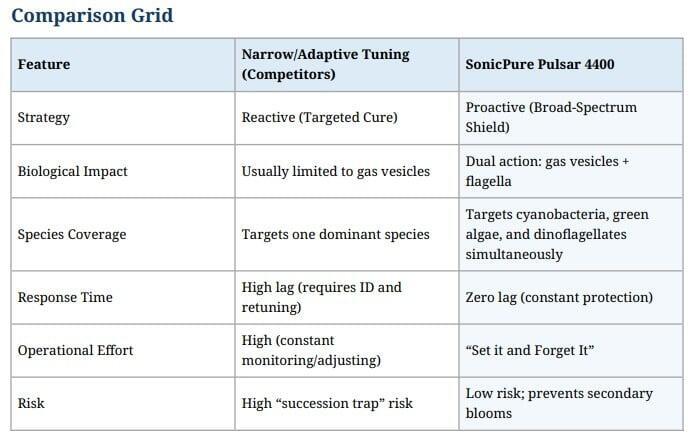
Many competitive systems use a reactive, narrowly tuned approach. They identify the current dominant algae species, then tune their hardware to a specific frequency intended to affect that single target.
At first glance, that may sound precise. In practice, it often creates a bigger problem: the succession trap.
When one dominant algae species is reduced, it can leave behind a biological opening for another species to rapidly take its place. Instead of solving the root problem, narrow tuning can trigger a cycle of recurring blooms, repeated identification, and ongoing recalibration.
Why that matters
- One species disappears, another takes over
- Retuning happens after the next bloom is already established
- Water clarity can still suffer, even when one target species is reduced
- Customers can get stuck in a loop of monitoring, testing, and adjustment
The SonicPure Difference: Broad-Spectrum Protection
SonicPure Pulsar 4400 takes a fundamentally different approach.
Instead of relying on narrow tuning for one current species, the Pulsar 4400 uses a constant broad-spectrum sweep of 4,400 discrete frequencies to target multiple biological mechanisms across the water column.
This gives operators a more proactive strategy for algae management and helps reduce the risk of species succession.
Two-Pronged Biological Approach
1. Buoyancy Disruption
The Pulsar 4400 is designed to target gas vesicles in cyanobacteria (blue-green algae), disrupting buoyancy and reducing their ability to remain in the light-rich upper water column.
2. Motility Disruption
The system also targets flagella, the cellular structures that enable movement in many green algae and dinoflagellates, including problematic species such as Chattonella and Heterosigma.
By affecting both buoyancy and motility, the Pulsar 4400 addresses more than the bloom that is visible today — it helps suppress the next one waiting behind it.
A Smarter, Simpler Operating Model
Set It and Forget It
Because the Pulsar 4400 operates with a constant 4,400-frequency sweep, there is no need for ongoing manual or AI-based retuning as species composition changes.
No Tuning Lag
Narrow systems depend on identifying the new dominant species and updating settings in time. The Pulsar 4400 avoids that delay by delivering continuous broad-spectrum coverage from day one.
Fewer Hidden Costs
Some competing approaches may require continued tuning services, species testing, or repeated adjustment. SonicPure is designed to provide inclusive, constant coverage without that ongoing complexity.
Why Decision Makers Choose Pulsar 4400
SonicPure Pulsar 4400 is built for operators who want:
- proactive algae suppression
- reduced operational complexity
- more consistent water clarity
- less dependence on retesting and retuning
- protection against species shifts and secondary blooms
In short, narrowly tuned systems react to the algae problem you already have. Pulsar 4400 is designed to protect against the one coming next.
Stop Chasing Blooms
Narrow tuning solves for one species at a time. SonicPure Pulsar 4400 delivers continuous, broad-spectrum protection designed to help prevent the next bloom before it takes hold.
Broad-Spectrum Algae Control Without the Retuning Cycle
Most systems are designed to react to the bloom you can already see. SonicPure Pulsar 4400 is designed to suppress multiple algae mechanisms at once with a constant sweep of 4,400 discrete frequencies. That means broader coverage, simpler operation, and less risk of the succession cycle that can undermine narrowly tuned systems.